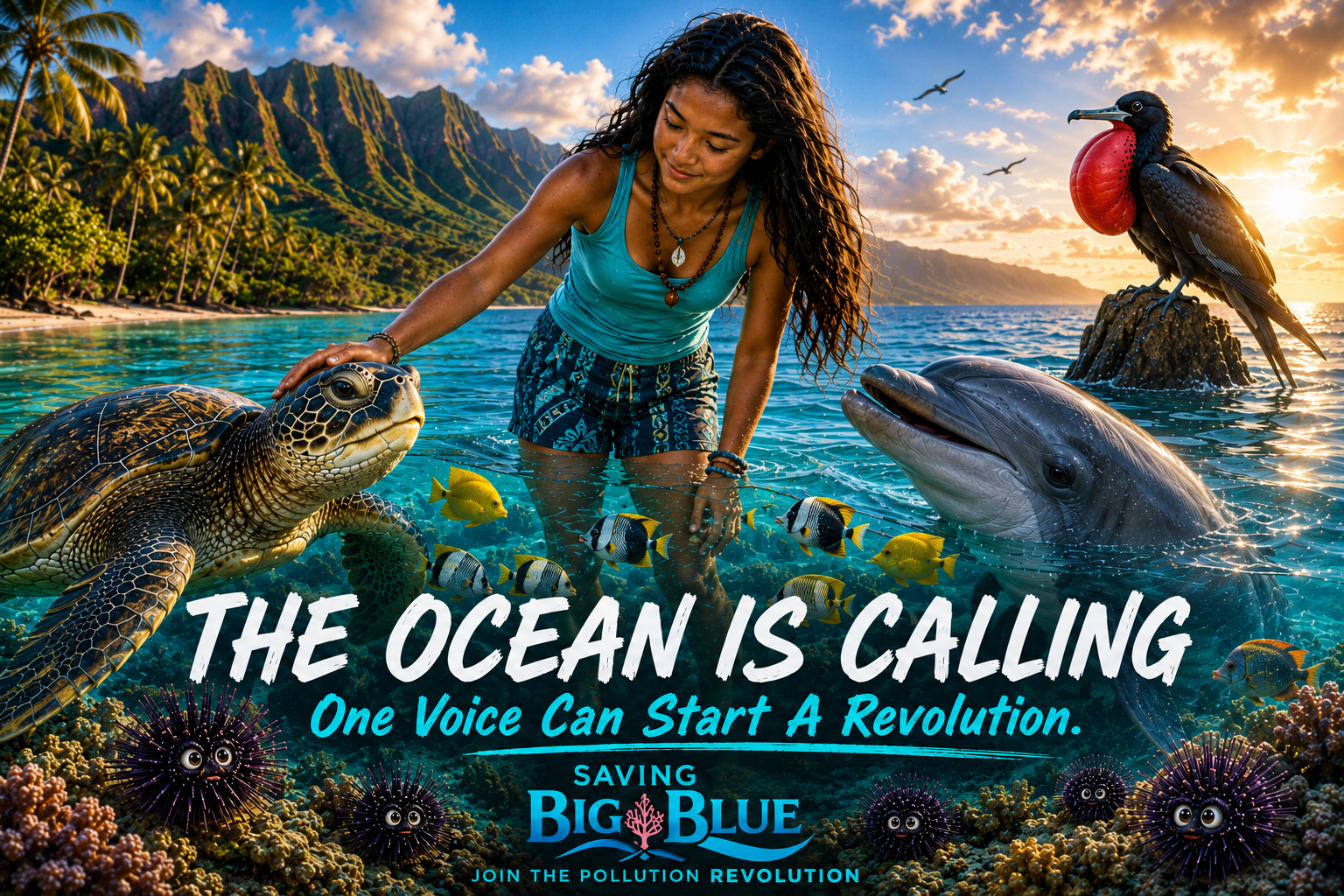
Images Created by Jeff Mustard using ChatGPT.
An ocean-pollution story can begin far from a beach: on a road, beside a curb, in the path rainwater follows after a storm. What enters a watershed does not always stay where it began.
A July 31, 2026 Ocean Conservancy article explains that tire wear releases particles containing natural and synthetic rubber. Some can travel from roads into waterways through runoff.
It also highlights 6PPD-quinone, a transformation product of a tire additive that is highly toxic to coho salmon.
This is a specific chemical hazard—not proof of identical effects in every fish, or simply another example of swallowing visible litter.
The scientists describe ongoing research with the University of Toronto into filtering runoff through green infrastructure, including rain gardens and bioswales. They are investigating feasibility at city scale; the article does not report final benefits from that work.
Saving Big Blue connects human life with underwater life through one shared ocean. The watershed provides a real counterpart to that idea. A person can be geographically distant from the shore and still have a relationship with what reaches it.
This is an invitation to look more closely at the places between us and the sea. Learn where local stormwater goes. Explore community projects that protect waterways. Ocean care can include the choices and infrastructure of a neighborhood that never hears a breaking wave.
Take a first step
Ask where your local stormwater drains and learn about projects that filter runoff before it reaches rivers and the coast.
Explore prevention and learning resources — https://www.savingbigblue.com/get-involved#reduce-ocean-plastic
Sources and further reading
Ocean Conservancy — What are Tire Wear Particles? — July 31, 2026 — https://oceanconservancy.org/blog/2026/07/31/tire-wear-particles/